
How to Choose the Right Fence for Sloped Blocks in Australia
Anyone who has considered fencing in the Hills District or across the Northern Beaches knows the story. Standard flat-ground techniques fall short the moment a boundary has to deal with a genuine slope. It calls for specialised methods, an accurate site survey, and a fencing team who knows how to keep it all secure and good-looking for years.
At Bill Gibson Fencing, we’ve spent over 40 years supplying and installing fences across Sydney’s steepest inclines. Here’s our guide to choosing the right fence for sloped blocks in Australia.
Challenges of Fencing on Uneven Ground
There are two techniques for tackling the sloped terrain when it comes to fencing.
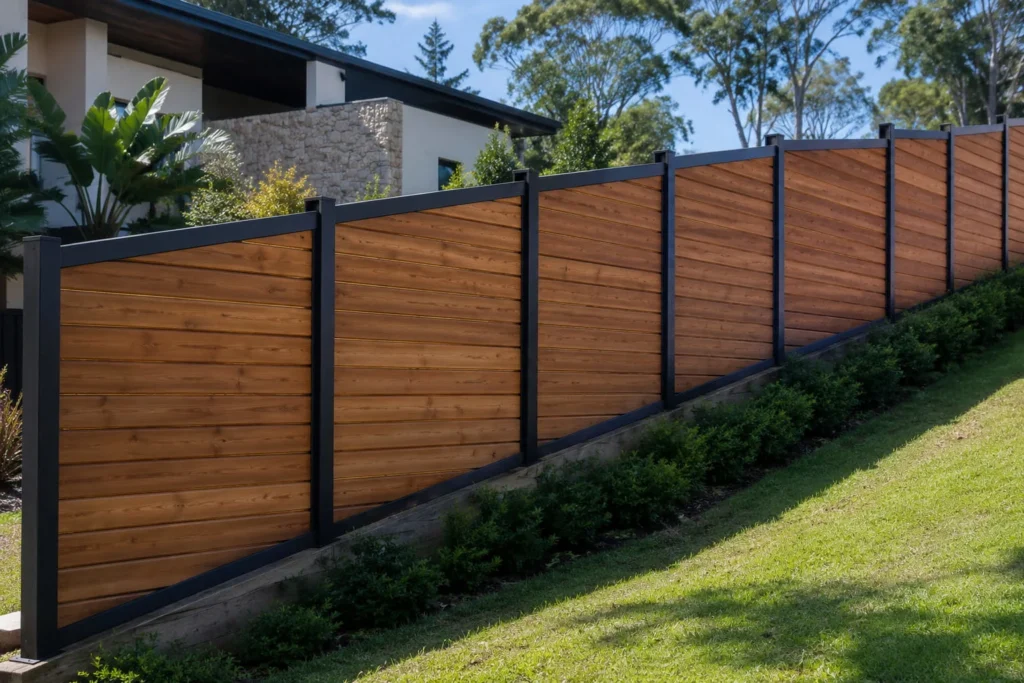
Raked fencing
- Raked fencing keeps the horizontal rails running parallel to the slope while every vertical stays plumb.
- It closes off any gaps at the base, which is why we often lean on it for timber installations on rolling blocks around Dural, Castle Hill, and Terrey Hills.
Stepped fencing
- Stepped fencing keeps each panel level, then raises or drops the next one down the post line.
- This creates a staircase effect for materials that aren’t flexible to follow the land contours.
Ready to Start Your Fencing Project?
Our experienced team is here to help you choose the right fencing solution.
Installing the Fence for Sloped Blocks
- Height limits are usually measured from the natural ground level, and stepped fences can sometimes exceed these limits at the highest point of the step.
- Do not block the natural flow of water with a solid fence base, as this can lead to hydrostatic pressure and structural failure. Consider sub-soil drainage pipes where necessary.
- Under the Dividing Fences Act, the cost of the fence is usually shared.
- Slopes can make it difficult to identify the exact boundary line. This is where an expert survey helps you avoid legal disputes.
Not sure which technique suits your block? Our installation team will walk the site with you and recommend raked or stepped based on the actual gradient, not a one-size-fits-all default.
Why Timber Remains the Most Adaptable Option for Slopes
Timber fencing is highly suitable for contouring land.
- Because materials such as treated pine or North Coast hardwood are cut and assembled on-site, a professional can adjust each paling to perfectly map the ground line.
- This raking approach keeps pets contained and stops topsoil washing underneath the boundary (known headaches for hillside property owners!).
Additionally, classic styles like picket fencing can be easily raked over gentle to moderate hills, enhancing kerb appeal while matching traditional architecture.
Colorbond® Fencing: The Best Option for Rigid Panel Fencing
If your property calls for a modern, high-privacy boundary, Colorbond® fencing is worth a look. Manufactured from rigid steel sheets, these panels provide exceptional durability against the elements.
- Because metal sheets cannot be bent to track the ground, Colorbond installations on hills must be cut perfectly to be raked.
You can always ask our team for more details on the techniques and solutions available in such cases.
High Visibility Options from Bill Gibson Fencing
For steep acreages or properties bordering bushland, solid panels tend to obstruct airflow and views.
- Our security fencing is built from tubular steel that can be fabricated to follow changes in elevation.
- Chainwire fencing does a similar job for long, sloping boundaries while staying cost-effective.
At Bill Gibson Fencing, both tubular steel and chainwire options can be custom fabricated to the height and length your site needs.
A Hybrid Solution for Sloped and Reactive Soils
Properties on steep gradients often deal with soil movement, putting immense pressure on boundary lines. Lapped-Lock Modular Steel Framed Timber Fencing is a robust solution in such cases.
- For homeowners who want the natural aesthetic of wood but require superior strength, hybrid systems offer an excellent alternative.
- Its heavy-duty steel frame delivers exceptional structural integrity to resist the pressures of shifting land, while the lapped timber infill provides a tidy, classic appearance.
By using high quality steel posts, this system prevents the leaning and sagging that can occasionally affect standard wooden structures on water-logged hills.
To sum up, a variety of options are available depending on the site conditions and your needs.
If you have a fencing project that needs to be executed over a sloped terrain, Bill Gibson Fencing can make it all possible and within your budget. Please visit us at Arndell Park, NSW orshare a detailed query to get the best fencing solutions and deals for you.
Ready to Start Your Fencing Project?
Our experienced team is here to help you choose the right fencing solution.
FAQs
Will a well-installed fence on a slope increase property value?
A professionally constructed boundary that manages a slope correctly improves kerb appeal and creates a more usable, secure outdoor space.
Does reactive clay soil affect sloped fencing differently?
Yes. Sloped land often experiences more soil movement during wet and dry cycles. For these conditions, we recommend the Lapped-Lock Modular Steel Framed system, as the steel frame provides the necessary rigidity to prevent the fence from warping or shifting.
What is the difference between raked and stepped fencing?
Raked fencing follows the angle of the ground, with the horizontal rails running parallel to the slope while the pickets remain upright. Stepped fencing keeps every panel perfectly level, creating a staircase effect as the fence moves down the hill.