
6 Key Differences Between Modular Fencing and Standard Panel Fencing
Modular fencing differs from standard panel fencing by offering superior acoustic insulation, a customisable appearance, easy installation with adaptation around slopes and pocket-friendly repairs. In this blog, we’ll discuss 6 differences to know about modular fencing and panel fencing while understanding suitability of each.
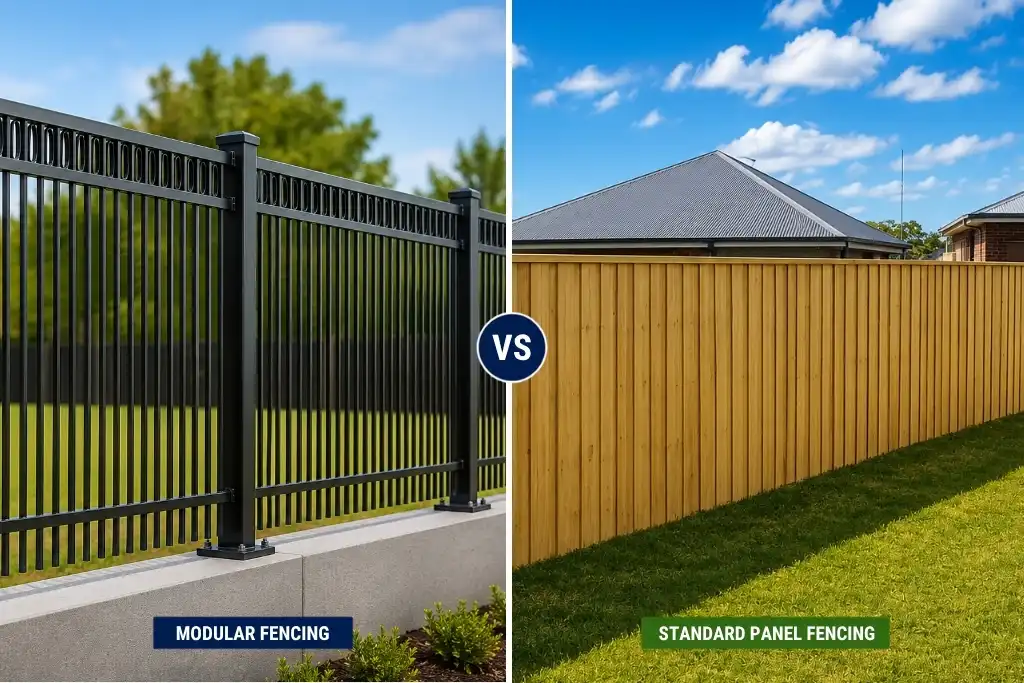
1. Terrain Adaptability: Raking vs Stepping
NSW has undulating terrain which creates challenges during perimeter installation.
Homeowners with varied preferences like to know about the options that come down to raking vs stepping their fences. The table below offers a quick overview.
| Installation Method | Standard Fence Panels | Modular Fencing Systems |
| Installation Approach | Installed using a stepped method | Installed using a raked method |
| How It Follows Slopes | Creates horizontal levels that descend like a staircase | Panels are assembled on-site and trimmed to match the exact ground contour |
| Appearance | Traditional stepped profile | Smooth, continuous fence line that follows the land |
| Additional Considerations | May require extra sleepers to help secure gaps for pets | Minimises gaps beneath the fence without additional sleepers in many situations |
Bill Gibson Fencing Insights: This is where our treated pine and North Coast Hardwood offerings truly shine. Explore them here.
Ready to Start Your Fencing Project?
Our experienced team is here to help you choose the right fencing solution.
2. Noise Management
Noise remains a concern for many homeowners. This is where dampening it for homes located near busy roads or urban hubs is essential.
Standard Panel Fencing is typically made of timber and provides an excellent visual screen. While they offer some sound deflection, their lighter mass makes them better suited for quiet cul-de-sacs or internal boundaries where noise mitigation is not the primary objective.
Modular Fencing or Lapped-Lock Modular Steel Framed Timber Fencing systems utilise high-density composite or fibre-cement panels. Because its panels are solid and interlock via tongue-and-groove joins, they create a noticeable acoustic barrier for homeowners.
3. Wind Loads
Sydney’s coastal and high-altitude regions experience high wind speeds, such as the Southerly Buster. That is why how a fence handles air pressure is a critical utility factor.
- Modular systems often feature small, uniform gaps between horizontal slats or interlocked panels that allow for controlled air movement or thermal expansion.
- Standard panels, particularly solid steel sheets, act like a sail. While they provide an excellent windbreak for the garden, they experience significantly higher structural stress during storms.
From our experience, modular designs have a slight edge here. They are often preferred in high-wind zones because they can distribute pressure more evenly across the post-and-rail architecture.
4. Repairability and Replacement
A fence is a long-term investment that may face accidental damage from fallen branches or garden equipment.
- In a standard panel system, damage to one area may require replacing the entire 2.4-metre section.
- Lapped-lock fencing is assembled from individual horizontal slats or panels, where if a single component is damaged, it can often be slid out and replaced independently. This reduces long-term repair costs and minimises material waste.
Bill Gibson Fencing Insights: If you’re handy with a level and a drill, then check the freight charges here and book all the necessary components in a single order.
5. Installation Efficiency and Project Timelines
Minimising disruption to your home life or business operations is a major priority for every job we schedule at Bill Gibson Fencing.
Standard timber boundaries require a dedicated construction process and a skilled team to execute it with total precision.
Modular fencing is specifically engineered for rapid deployment. When you opt for these, our crews can often secure your perimeter much faster.
Regardless of the materials you select, Bill Gibson Fencing has the resources and expertise to handle your supply and installation requirements for projects of any size.
Ready to Start Your Fencing Project?
Our experienced team is here to help you choose the right fencing solution.
6. Customisation and Aesthetic Appeal
Standard panel fencing offers a classic and timeless visual that blends perfectly with traditional suburban homes across NSW.
Conversely, Lapped-lock systems deliver a sleek and modern finish, often providing a premium look.
Drawing on our decades of real world experience at Bill Gibson Fencing, we can confidently say that this comes down to individual preferences and the immediate surroundings.
So, what’s the final take?
Standard panel fencing remains the gold standard for versatility and cost-efficiency. Modular fencing is preferred for upgrades where noise pollution, high-end aesthetics, and long-term durability are the primary goals.
But what if we tell you that there’s also a new kid on the block!? Read more about it here and send any queries you might have with Bill Gibson Fencing options. But if you’ve already made up your mind, head here for a free quote and the best fencing prices in NSW.
FAQs
Q. Does modular fencing improve property value more than standard panels?
Because modular fencing offers a masonry-like appearance and superior soundproofing, it is often considered a high-end architectural feature. This can contribute more to the kerb appeal and perceived value of a modern home renovation compared to a standard utilitarian timber fence.
Q. How easy is it to repair a timber fence?
Timber is highly modular in its own right. If a single pale or rail is damaged by a fallen branch or impact, that specific piece can be removed and replaced without disturbing the rest of the fence. This localised repairability is a major utility advantage for long-term maintenance.
Q. How does timber handle contact with soil?
H4-rated treated pine posts are specifically engineered for in-ground use. They are treated to resist moisture and subterranean termites, ensuring the fence’s structural foundation remains intact for many years, even in damp soil conditions.
Q. How difficult is it to repair a single panel in a modular fence?
Modular fences are highly repairable. If one panel is damaged by an impact, the capping can be removed, and the individual panel can be slid out and replaced. In a standard timber fence, the boards are often interlocked or nailed, requiring a larger section to be dismantled for a tidy repair.
Q. Can I use modular fencing as a retaining wall?
These specialised fencing systems are purely boundary markers and cannot withstand the lateral pressure of retained soil. At Bill Gibson Fencing, safety is a priority. We strongly discourage using them for unintended purposes as they can invite serious hazards.